A patient portal for cancer risk care
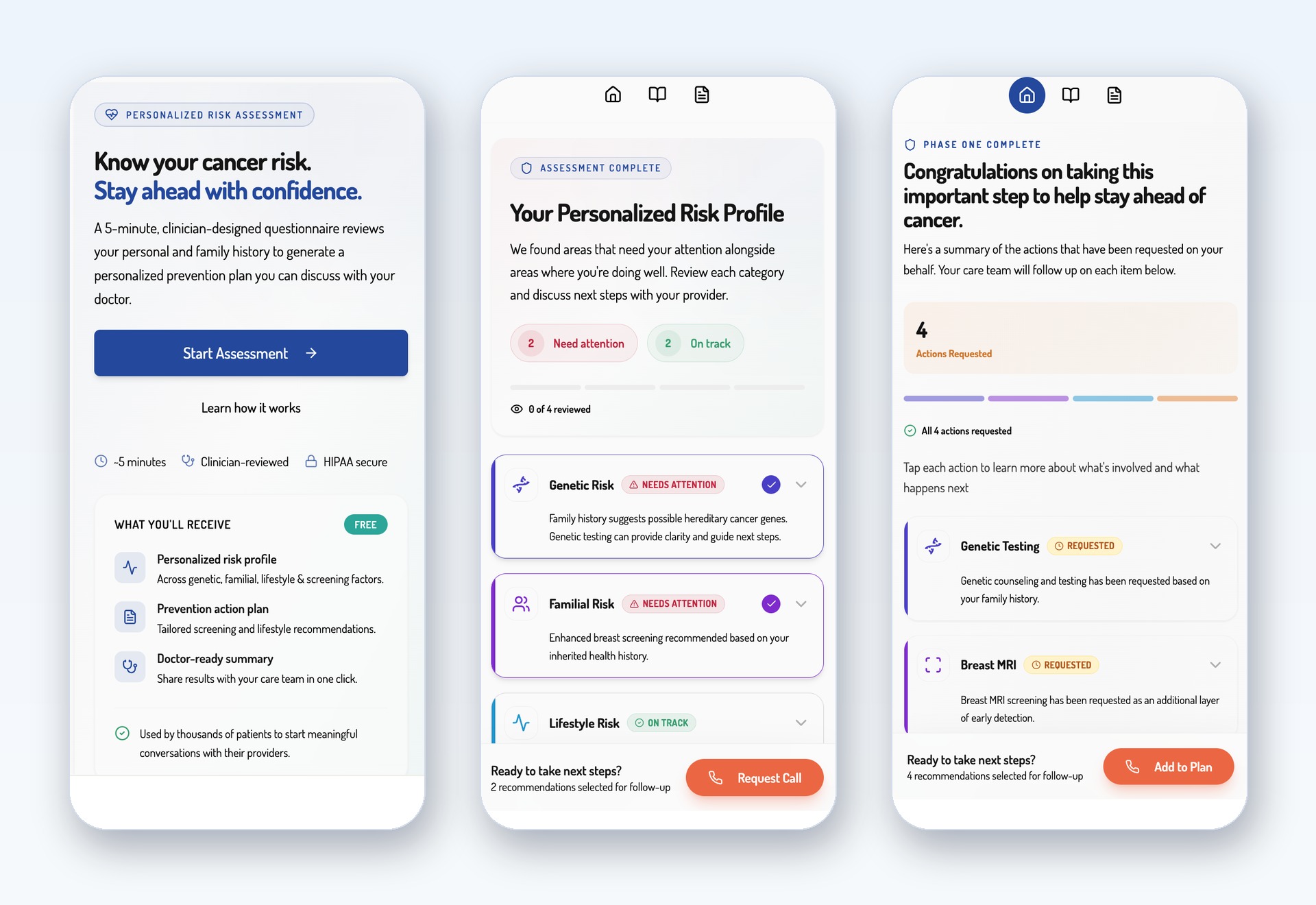
End-to-end design of CancerIQ's patient-facing portal — multi-organ risk reports, screening planning, follow-ups, and education in one calm experience.
Role
Sr Product Designer (solo)
Team
Solo designer with PMs, engineers, and clinical SMEs
Duration
Ongoing
Year
2023 — now
Context
CancerIQ is a healthcare platform used by clinics to manage cancer risk assessment and screening programs — and one of TIME's World's Top 100 HealthTech Companies 2025. As the sole product designer, I lead UX and UI across a complex clinician-facing platform and the new patient experience.
The problem
Patients receiving risk-disclosure results often had nowhere coherent to land. The information was clinical, dense, and time-sensitive, but the surrounding experience didn't help them plan screenings, understand follow-ups, or learn about their condition at their own pace.
Approach
- 01
Designed the patient portal from scratch — end-to-end flows for viewing multi-organ cancer risk reports, planning screenings, receiving follow-ups, and accessing educational content tied to the patient's specific risks.
- 02
Redesigned complex clinician dashboards to improve data hierarchy, filtering, and workflow efficiency, so the people delivering care spend less time wrangling the tool.
- 03
Established clearer interaction patterns and a visual system across the platform, then maintained the design system as new modules shipped.
- 04
Introduced AI tools into the design process — using rapid prototyping to validate ideas in real workflows with clinicians and patients before engineering committed.
Outcome
Reflection
Healthcare design is mostly an act of restraint. The platform manages life-altering information; my job is to make every screen feel calm, predictable, and trustworthy — and to leave room for the clinician–patient relationship to do the heavy lifting.